Detailed image description
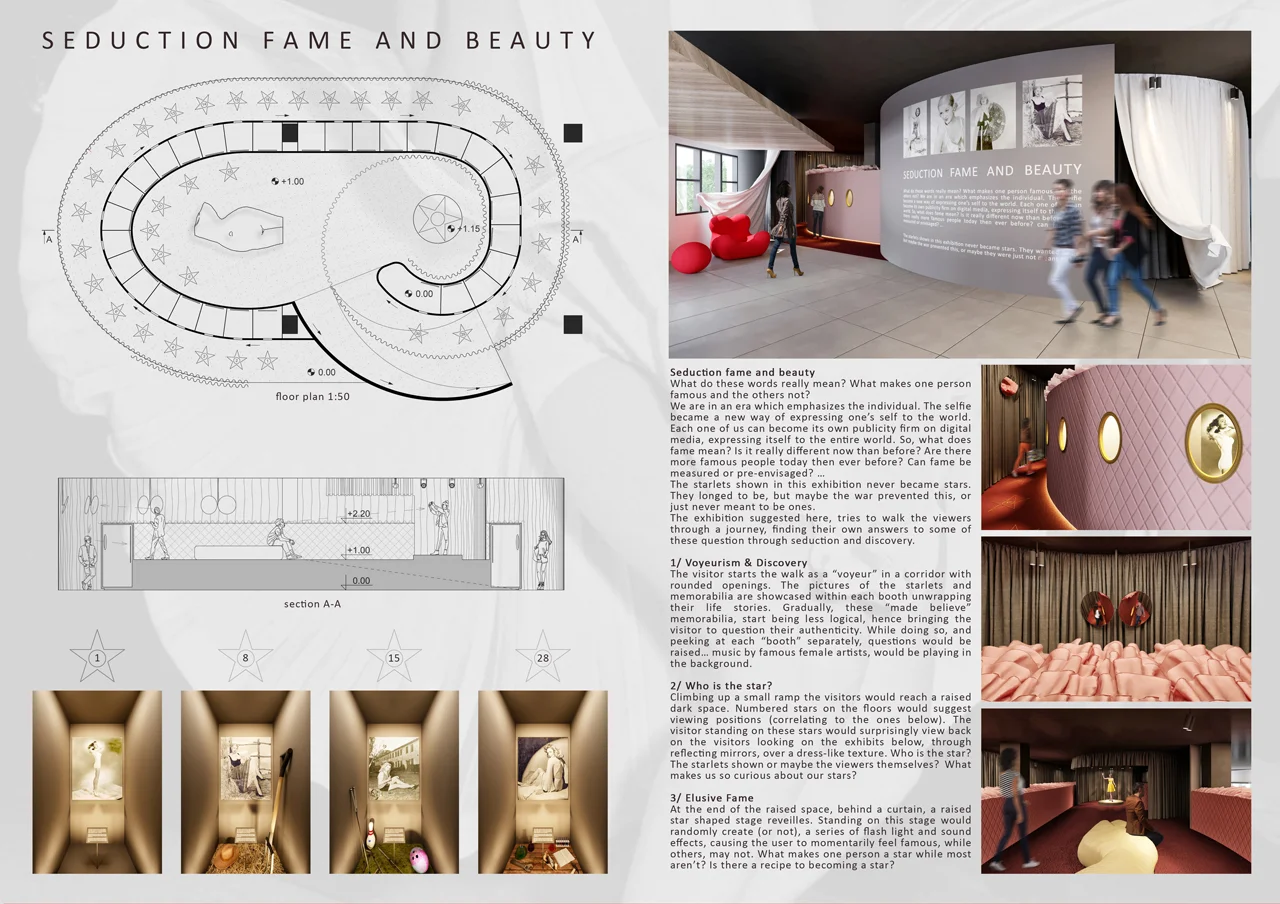
Exhibition presentation board headed “SEDUCTION FAME AND BEAUTY”. An oval, curling route wraps around a raised central area. A row of small display compartments lines the curve, with star markers on the floor. A sectional drawing shows the central platform above the surrounding route. Renderings show a pink padded curved wall with circular viewing holes, a curtained central room and a small star-shaped stage. Four illuminated display compartments contain photographs and objects.
Introduction and visitor sequence, transcribed from the companion sheets:
What do these words really mean? What makes one person famous and the others not? We are in an era which emphasizes the individual. The selfie became a new way of expressing one’s self to the world. Each one of us can become its own publicity firm on digital media, expressing itself to the entire world. So, what does fame mean? Is it really different now than before? Are there more famous people today then ever before? Can fame be measured or pre-envisaged? ... The starlets shown in this exhibition never became stars. They longed to be, but maybe the war prevented this, or just never meant to be ones. The exhibition suggested here, tries to walk the viewers through a journey, finding their own answers to some of these question through seduction and discovery.
The visitor starts the walk as a “voyeur” in a corridor with rounded openings. The pictures of the starlets and memorabilia are showcased within each booth unwrapping their life stories. Gradually, these “made believe” memorabilia, start being less logical, hence bring the visitor to question their authenticity. While doing so, and peeking at each “booth” separately, questions would be raised... music by famous female artists, would be playing in the background.
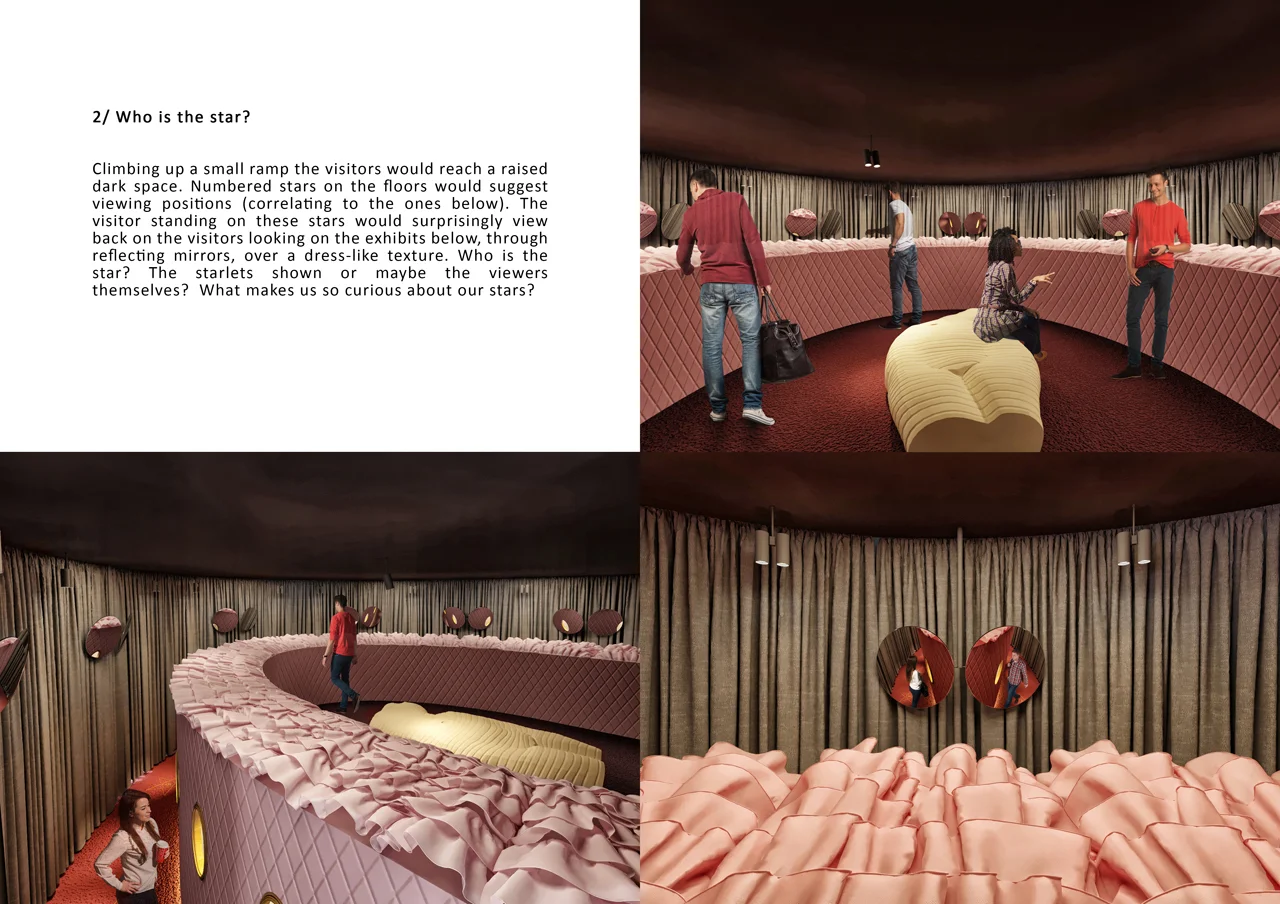
Climbing up a small ramp the visitors would reach a raised dark space. Numbered stars on the floors would suggest viewing positions (correlating to the ones below). The visitor standing on these stars would surprisingly view back on the visitors looking on the exhibits below, through reflecting mirrors, over a dress-like texture. Who is the star? The starlets shown or maybe the viewers themselves? What makes us so curious about our stars?
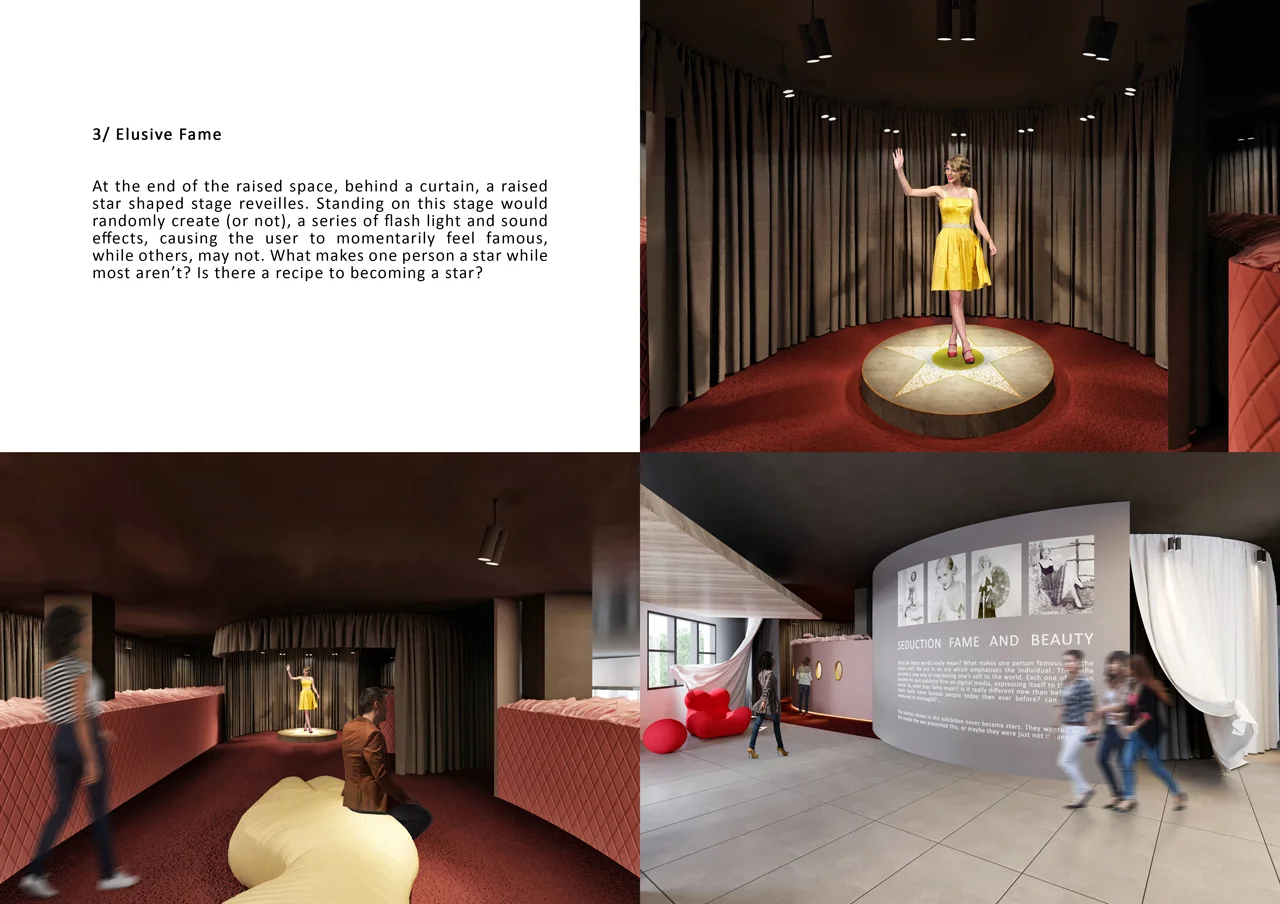
At the end of the raised space, behind a curtain, a raised star shaped stage reveilles. Standing on this stage would randomly create (or not), a series of flash light and sound effects, causing the user to momentarily feel famous, while others, may not. What makes one person a star while most aren’t? Is there a recipe to becoming a star?
Detailed image description
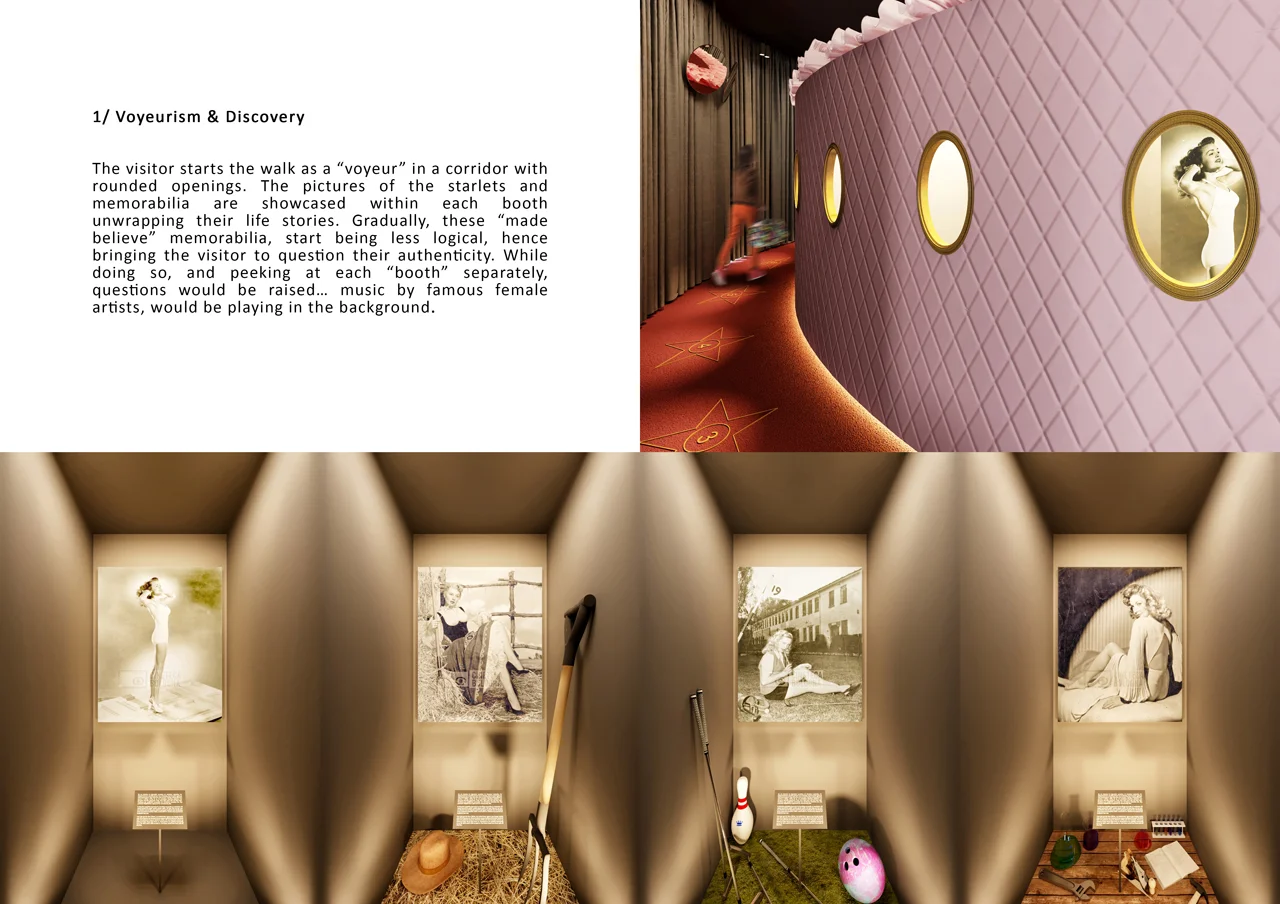
Exhibition sheet headed “1/ Voyeurism & Discovery”. The upper view shows a curved pink diamond-patterned wall with round viewing openings set in gold-coloured rims. The lower view shows four tall illuminated compartments containing portrait photographs and small objects.
Text shown on the board:
The visitor starts the walk as a “voyeur” in a corridor with rounded openings. The pictures of the starlets and memorabilia are showcased within each booth unwrapping their life stories. Gradually, these “made believe” memorabilia, start being less logical, hence bring the visitor to question their authenticity. While doing so, and peeking at each “booth” separately, questions would be raised... music by famous female artists, would be playing in the background.
Detailed image description
Exhibition sheet headed “2/ Who is the star?”. Renderings show visitors standing along an upper route around a curved pink padded wall. A lower view shows a visitor looking through round openings; another shows mirrors mounted against curtains above the textured display.
Text shown on the board:
Climbing up a small ramp the visitors would reach a raised dark space. Numbered stars on the floors would suggest viewing positions (correlating to the ones below). The visitor standing on these stars would surprisingly view back on the visitors looking on the exhibits below, through reflecting mirrors, over a dress-like texture. Who is the star? The starlets shown or maybe the viewers themselves? What makes us so curious about our stars?
Detailed image description
Exhibition sheet headed “3/ Elusive Fame”. A rendering shows a visitor on a raised circular platform with a star motif, surrounded by curtains and spotlights. Other views show the platform within the dark inner space and the curved introductory wall at the entrance.
Text shown on the board:
At the end of the raised space, behind a curtain, a raised star shaped stage reveilles. Standing on this stage would randomly create (or not), a series of flash light and sound effects, causing the user to momentarily feel famous, while others, may not. What makes one person a star while most aren’t? Is there a recipe to becoming a star?
Detailed image description
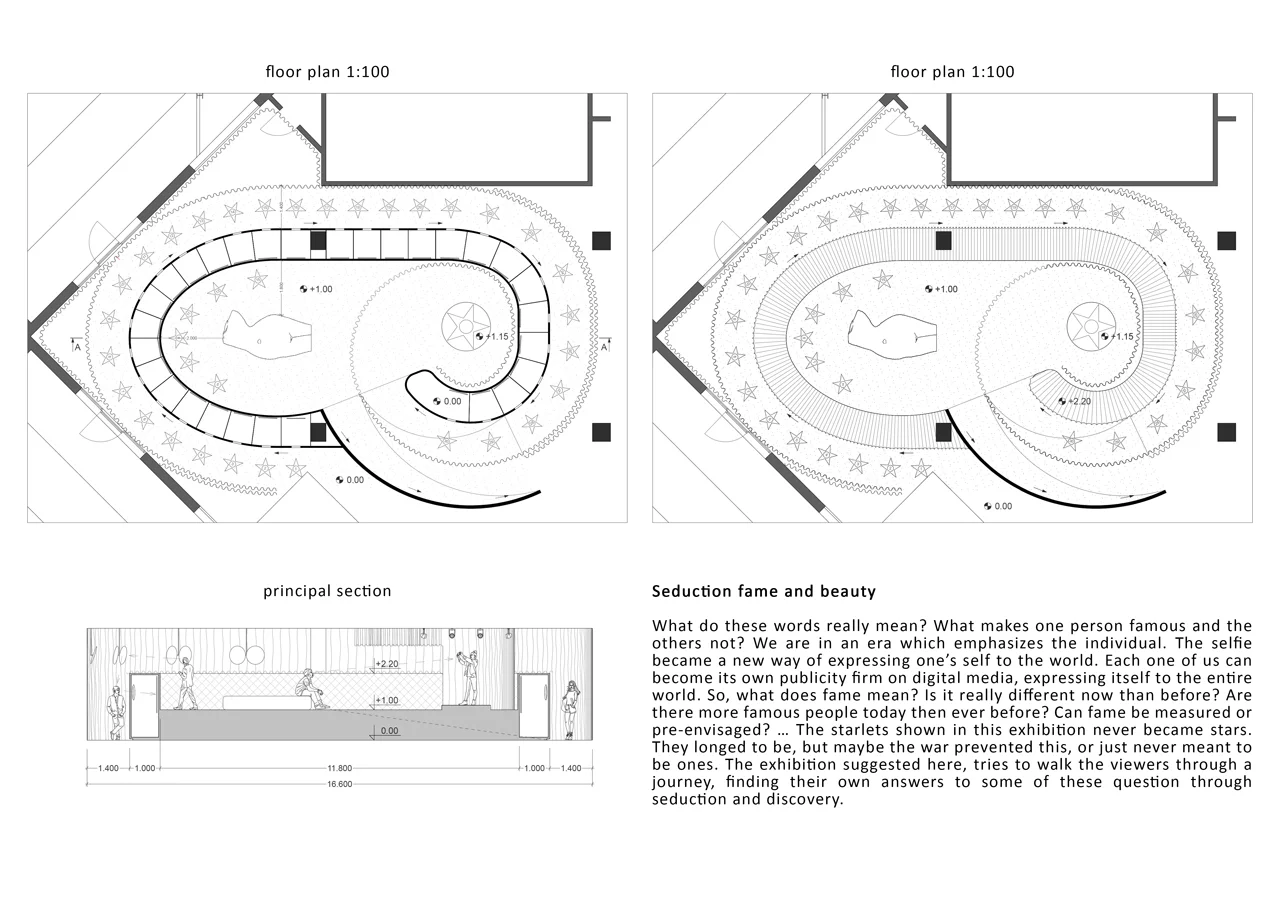
Two floor plans at 1:100 and a principal section describe a curling, oval exhibition layout. The surrounding circulation route starts at level 0.00; the inner platform is marked +1.00 and a circular star stage +1.15. Display compartments line the inner curve, with star-shaped viewing markers on the floor. The section also marks +2.20 and an overall width of 16.600.
Text shown under “Seduction fame and beauty”:
What do these words really mean? What makes one person famous and the others not? We are in an era which emphasizes the individual. The selfie became a new way of expressing one’s self to the world. Each one of us can become its own publicity firm on digital media, expressing itself to the entire world. So, what does fame mean? Is it really different now than before? Are there more famous people today then ever before? Can fame be measured or pre-envisaged? ... The starlets shown in this exhibition never became stars. They longed to be, but maybe the war prevented this, or just never meant to be ones. The exhibition suggested here, tries to walk the viewers through a journey, finding their own answers to some of these question through seduction and discovery.
Detailed image description
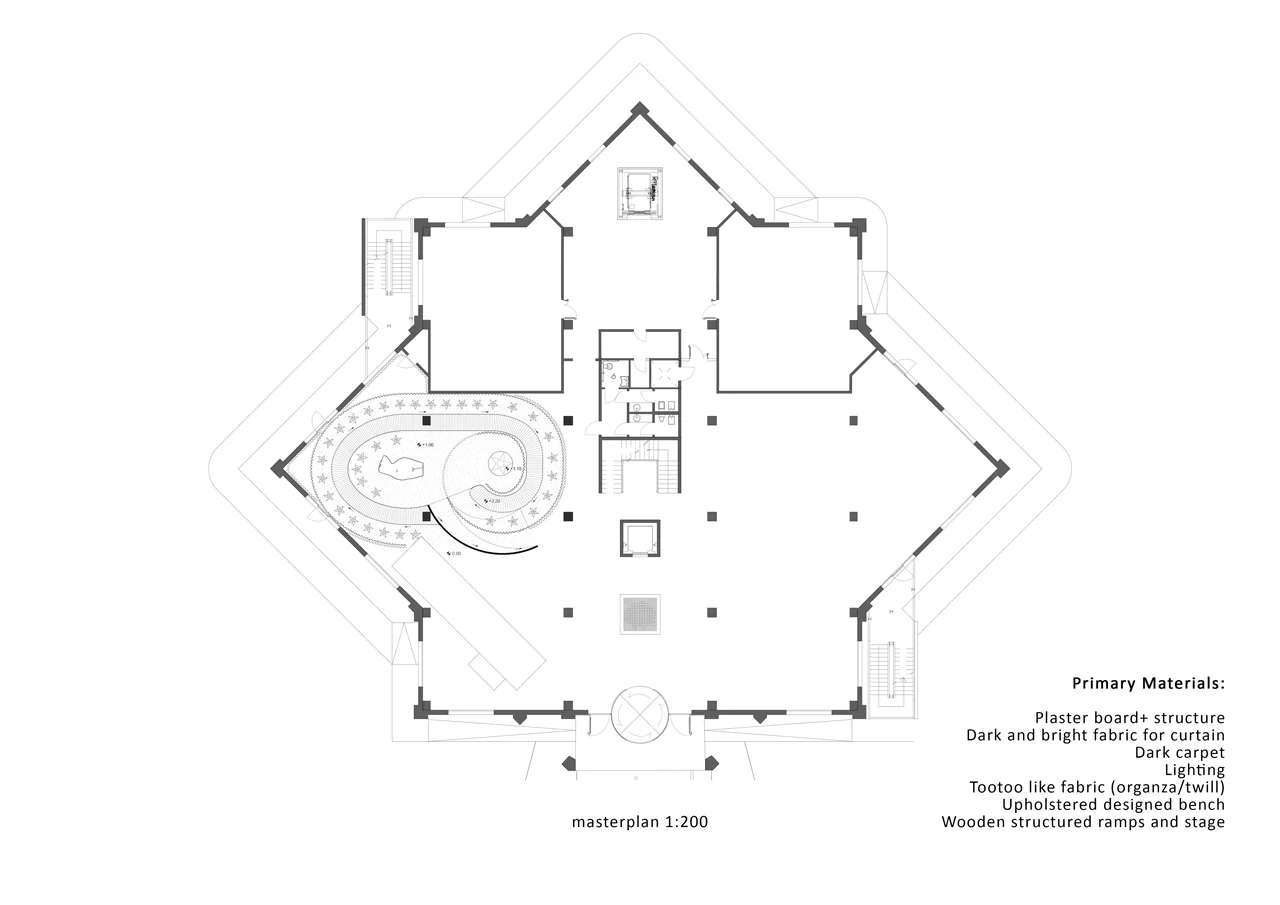
Masterplan at 1:200 showing the oval exhibition within the left side of a larger floor. The building has angled outer walls, a central group of service rooms and stairs, and a main entrance at the bottom. Open space occupies the right side; enclosed rooms occupy the upper corners.
Primary Materials, as listed on the sheet:
Plaster board + structure.
Dark and bright fabric for curtain.
Dark carpet.
Lighting.
Tootoo like fabric (organza/twill).
Upholstered designed bench.
Wooden structured ramps and stage.